


The beginning of Christianity. The work of the Apostles after the death of Christ.
Fifty days after the resurrection of Christ, Pentecost occurs, or the day when the Holy Spirit permeates the lives of Christ's 12 disciples , giving them the impetus to spread the work of Jesus Christ. From then on, they become apostles , with the mission of spreading one of the world's greatest religious faiths. It is the beginning of Christianity.

According to the book of ACTS OF THE APOSTLES, chapter 2, all the disciples were gathered to celebrate Shavuot, a Jewish holiday commemorating the giving of the Ten Commandments by God to Moses. " Suddenly a sound like the blowing of a violent wind came from heaven and filled the whole house where they were sitting. They saw what seemed to be tongues of fire that separated and came to rest on each of them. All of them were filled with the Holy Spirit and began to speak in other tongues as the Spirit enabled them."

The beginning of Christianity. The work of the Apostles after the death of Christ.
Pentecost Day signifies the beginning of Christianity. From that day, with the power of the Holy Spirit, Christ's apostles traveled, spreading the faith, deeds, and miracles of Jesus Christ. Christianity thus grew in various parts of the world. Curious Faith researched where each apostle preached the Christian faith, what their main acts were, and how each of them died. With the exception of the apostle John, all are considered martyrs, confirming their belief in Jesus Christ at the moment of their death.
APOSTLE JAMES THE GREATER (The Elder) - SANTIAGO
James was a fisherman who lived in Judea in the regions of Bethsaida, Capernaum, and Jerusalem. He was one of the three apostles closest to Jesus. His work took place in the Iberian Peninsula region, encompassing present-day Spain and Portugal.

In Spain, he concentrated his work in the ancient Roman city of Iria Flavia, near the city of Santiago de Compostela. He also preached in Saragossa, a city where he experienced a moment of discouragement due to the few conversions he had achieved. However, it was there that the miracle of the Apparition of the Virgin Mary on a marble pillar occurred, encouraging him to continue spreading the message of Jesus and to build a church, which today is the Basilica of Our Lady of the Pillar. At the end of his life, he returned to Jerusalem and preached throughout the region of Judea, helping to build and lead the local Early Christian Church. At the behest of Herod, James was beheaded around 44 AD. His body was transferred to the city of Santiago de Compostela, the arrival point of the world's most famous Christian pilgrimage.
Apostle Andrew - Saint Andrew
Like James the Greater, Andrew was a fisherman and also lived in the region of Bethsaida and Capernaum. Along with the apostle John the Evangelist, he was a disciple of Saint John the Baptist. His work of expanding Christianity took place on the shores of the Black Sea, preaching in various places that today correspond to Romania, Ukraine, and southern Russia. He even preached in the hills of the Dnieper River, the site where the city of Kyiv, the capital of Ukraine, would be founded.

He preached in the city of Byzantium, present-day Istanbul in Turkey. He founded the headquarters of the Church in Byzantium in 38 AD, where he proclaimed Saint Statius as the first local bishop. Later, this place would become the Patriarchate of Constantinople, making Saint Andrew the patron saint of the Orthodox Christian Church. He also evangelized Roman provinces in present-day Turkey. His last years were spent in Greece in the regions of Thrace, Macedonia, and Achaia. He died in Patras in the province of Achaia. He was condemned by the Roman governor Aegeas to die crucified, around 63 AD. He was a martyr. He did not abandon the Christian faith. Andrew asked to be tied to an X-shaped cross, as he did not consider himself worthy to die in the same position as Jesus. The X-shaped cross is known as the Cross of Saint Andrew.
Apostle Bartholomew - Saint Bartholomew - or Nathanael
The apostle Bartholomew did much of his work alongside the apostles Philip and Luke Thaddeus. He preached primarily in Armenia and India, passing through regions of Mesopotamia (present-day Iraq), Persia (present-day Iran), and Lycaonia (present-day Turkey). His work had the greatest impact in Armenia, where, together with the apostle Luke Thaddeus, he converted thousands of people, including King Polymius and his wife. The Armenian Apostolic Church venerates him as one of its founding patron saints. He was martyred and flayed alive with knives at the behest of Astyages, king of Armenia, in 51 AD. Afterwards, he was beheaded.

APOSTLE JAMES THE LESS (The younger)

The apostle James the Less is identified as a brother or close relative of Jesus Christ, as written in the Gospel of Mark, chapter 6. Unlike the other apostles, James the Less did not travel to other locations, remaining in Jerusalem for several decades. He focused his preaching on the Jewish-Christian community. He assumed the position of Bishop of Jerusalem. In 50 AD, James the Less presided over the Council of Jerusalem, an event where it was decided that Gentiles (non-Jews) did not need to undergo circumcision upon conversion. He died in 62 AD, thrown from the pinnacle (peak) of the temple and then stoned, by order of the Jewish authorities.
APOSTLE JOHN THE EVANGELIST

He was the youngest among the disciples. He was one of the main leaders among them, along with Simon Peter. He was the only apostle who accompanied Jesus until his death on the cross. He preached in the regions of Jerusalem, Judea, Samaria, and among the Churches of Asia Minor. He was exiled to the Island of Patmos (Greece), where he wrote the Book of Revelation in the Bible. He died of natural causes in the city of Ephesus (Turkey), around 100 AD. He was not martyred.
APOSTLE JUDE THADDEUS

Along with the apostle Saint Bartholomew, he is considered one of the founders of the Armenian Apostolic Church. The apostle Judas Thaddeus is the brother of the apostles James the Less and Simon the Zealot. Judas Thaddeus should not be confused with the apostle Judas Iscariot, the betrayer of Jesus. Judas Thaddeus preached in Mesopotamia (present-day Iraq), Syria, Armenia, and Persia (present-day Iran). Tradition says that he died in the region of present-day Lebanon around 62 AD.
APOSTLE MATTHEW

In the Gospels, Matthew is cited as Levi, a tax collector who worked in Capernaum. Levi was probably his original name. Matthew was a name he adopted when he became a follower of Jesus. Matthew preached for about 15 years in the region of Judea, the period in which he wrote his Gospel (around 80 AD). Afterwards, he traveled to Persia (present-day Iran), Arabia, and Ethiopia, where he was supposedly martyred. Another version says he died in Hierapolis (southwest Turkey). His remains are now in Salerno, Italy.
APOSTLE PETER - SIMON PETER
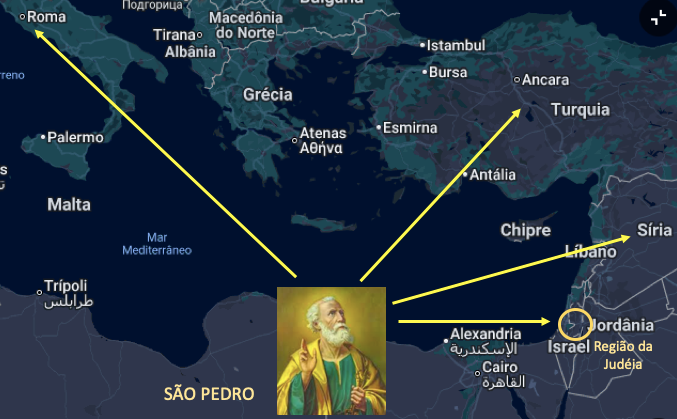
Simon Peter was a fisherman who lived in Bethsaida and Capernaum. Originally, his name is Simon in Greek and Cephas in Hebrew. However, both can be translated as "ROCK," hence the name Peter. His first major public appearance was in Jerusalem, resulting in the conversion of about 3,000 people. Peter preached in the region of Judea and Samaria, in Antioch in Syria, being cited as the first bishop of Antioch; in the interior of Asia Minor, and his final destination was Rome. There, he helped to form the Christian community. In 64 AD, he was martyred at the request of Nero. He was crucified upside down. The Vatican Basilica was built over his tomb.
APOSTLE PHILIP

Philip, like other apostles, lived in Bethsaida and was a fisherman. He was the one who invited the apostle Bartholomew (or Nathanael) to meet Jesus. Tradition says that the Apostle Philip preached in regions of Greece, Syria, Egypt, and later continued his work in the regions of Phrygia in Turkey. He was crucified (or hanged on a pillar) and stoned in Hierapolis (Turkey) around 80 AD, after bothering the local authorities by combating pagan cults. The Apostle Philip (one of the 12 disciples of Jesus) should not be confused with the figure of the Evangelist Philip (deacon) who preached in the region of Judea, Samaria, and the Gaza Road.
APOSTLE SIMON - THE ZEALOT
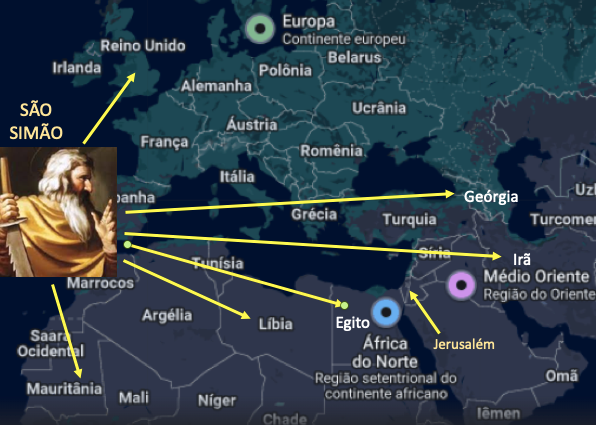
The title "ZEALOT" refers to the fact that SIMON was a member of a radical Jewish group that fought against Roman domination. Among the apostles, SIMON traveled the furthest to preach the Christian faith. It is mentioned that he preached in GREAT BRITAIN and also in NORTH AFRICA, MAURITAMIA and LIBYA. He also preached in EGYPT and in the region of present-day GEORGIA. Along with the Apostle JUDAS THADDEUS, he is considered the evangelizer of PERSIA and MESOPOTAMIA. His martyrdom occurred in PERSIA for refusing to worship pagan gods. He was sawn in half. It is common to depict him next to a saw.
APOSTLE THOMAS

Thomas is known for his disbelief in the actions of Christ. Thomas, another version of his name, means "twin" in Aramaic. His preaching took place in regions of ancient Persia (present-day Iran and Iraq) and Ethiopia. His main work was in India, where he is known as the Apostle of India. He preached on both coasts of India: on the Malabar Coast, where he founded 7 early Christian communities, and on the Coromandel Coast (Chennai). Thomas was martyred in 72 AD while praying at a pillar in the city of Chennai, being pierced by spears. The Basilica of St. Thomas was erected on the site of his tomb.
APOSTLE MATTHIAS

Matthias was chosen by the other apostles to replace Judas Iscariot. He is called a posthumous apostle. It is said that Matthias founded the Church of Cappadocia and served Christians on the shores of the Caspian Sea. There are also records of preaching in Ethiopia. His death occurred around 80 AD. The most accepted version states that he stood before a council of elders in Jerusalem, which condemned him for preaching the Gospel. He was stoned alive and finally beheaded with an axe by Roman soldiers.
FINISHING UP...
Curious Faith would also like to emphasize the apostolic work of SAINT PAUL. PAUL OF TARSUS was the author of the Pauline epistles contained in the Bible. His work was very important for the development of Christianity, to the point that many scholars consider him the most important apostle in the development of the religion. See his story at https://www.fecuriosa.com/post/paulo-de-tarso-a-expans%C3%A3o-do-cristianismo

Comments